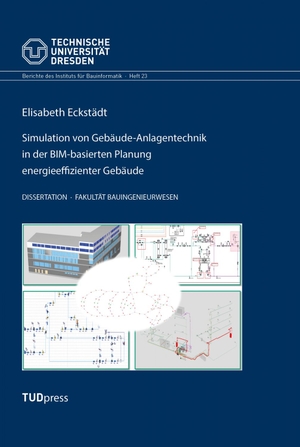
Elisabeth Eckstädt
Simulation von Gebäude-Anlagentechnik in der BIM-basierten Planung energieeffizienter Gebäude
- TUDpress
- 2025
- Taschenbuch
- 222 Seiten
- ISBN 9783959088206
Die Einbindung von Anlagensimulation in den Planungsprozess von technischer Gebäudeausrüstung trägt zu einem energieeffizienteren Betrieb von Gebäuden bei. Eine wesentliche Hürde bei der Anwendung der Simulation als Planungswerkzeug ist der Aufwand für die Modellerstellung. Diese Arbeit beschäftigt sich mit der automatisierten Modellerstellung basierend auf BIM (Building Information Management)-Modellen, um diesen Aufwand zu verringern. Weiterhin wird die Nachnutzung erstellter Simulationsmodelle durch die Erstellung von BIM-Modelen betrachtet. Im Rahmen der Arbeit wurden Werkzeuge für die bidirektionale Verbindung zwischen BIM- und Simulationsmodell erstellt. Die Betrachtungen fokussieren sich dabei auf das Simulationsformat Modelica und das open-BIM-Format IFC. Die implementierten Werkzeuge basieren auf einer Analyse der Ausdrucksmächtigkeit der gewählten Formate (IFC
The integration of system simulation into the design process for HVAC equipment contributes to more energy-efficient operation of buildings. A major hurdle in the application of simulation as a design tool is the effort involved in modelling. This work deals with the automated modelling based on BIM (Building Information Management) models in order to reduce this effort. Furthermore, the utilisation of simulation models that have been created through the generation of BIM models is considered. Tools for the bidirectional link between BIM and simulation models were created as part of the work. The considerations focus on the simulation format Modelica and the open BIM format IFC. The implemented tools are based on an assessment of the expressiveness of the selected formats (IFC and Modelica) and the information requirements of the selected simulation scenario in the two use cases BIM2SIM and SIM2BIM. Knowledge graphs were used as intermediate knowledge representation for the model transfer. This enables the application of semantic technologies already developed in IT for the translation between BIM and simulation. Additionally, the knowledge graphs provide starting points for use cases that go far beyond the use cases investigated in this thesis.
Mehr
Weniger
zzgl. Versand
Auf Lager